
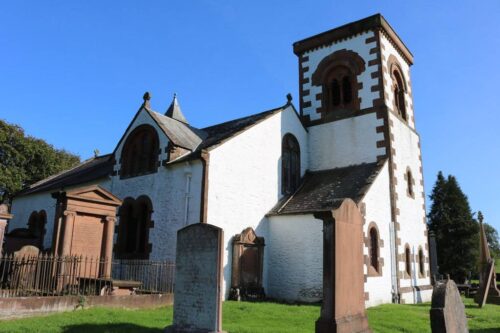
 There has been a Kirk at Kirkpatrick Irongray since Celtic times, it’s walls rebuilt so many times and most recently in 1872 when the tower was added.
Irongray folk took part in the struggles for civil and religious freedom in the Covenanting cause.
The Scottish Reformation of 1560 established the Presbyterian Church of Scotland but both James 1 and Charles 1 attempted to bring it into line with the English Church by imposing the English Prayer Book and restoring bishops to govern the church. The signing of the National Covenant in 1638, in parishes throughout Scotland, registered opposition to these moves and led to open rebellion against the King.
The Solemn League and Covenant of 1643 sided the Covenanters with the English Parliament against Charles 1 in the Civil War and guaranteed Presbyterianism during the protectorate of Oliver Cromwell. However, with the restoration of the monarchy in 1660 Charles 11 set out to govern the Scottish Church through bishops. Strong resistance was encountered in South West Scotland; many clergymen were expelled from their churches for failing to comply with the new arrangements, but continued to minister to their congregations through open air conventicles, John Welsh, the minister at Irongray was one such who lost his living in 1662; a grandson of John Knox, he became a resistance leader and field preacher.
Still to this day lying on Skeoch Hill are the Communion Stones where, in 1678, three thousand took communion in the silence and safety of this remote moorland. A granite memorial marks this spot for anyone willing and able to walk up and over the rough terrain.
During these dark days known as The Killing Times, in 1685 six Covenanters were caught at Lochenkit – four were executed on the spot, the remaining two were hanged on the oak tree at Hallhill.
The Kirkyard at Irongray has many interesting gravestones, some dating from the 16th century. A more recent one is the gravestone in the memory of Jane Haining, missionary in Budapest who refused to abandon her Jewish orphan charges in 1939 and perished in Auschwitz.
The village of Shawhead was the main community in the parish, having a flourishing blanket factory in Victorian times owned by McGeorge the world famous knitwear firm.